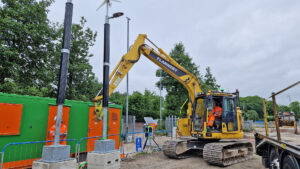

Bring dependable lighting to remote, peripheral and difficult-to-connect locations without extending mains power simply to serve the lights.
ReLuminate® hybrid solar-wind lighting provides autonomous illumination for car parks, access routes, pathways, compounds, boundaries and other permanent applications – without trenching, cabling or a grid connection.
Permanent lighting usually means extending mains power to the lighting point. Where electrical infrastructure is already close by, that can make perfect sense.
But where reaching the location means excavation, ducting, cabling, road crossings or reinstatement, the infrastructure needed to power the lights can become a much bigger project. ReLuminate® provides another option: generate and store energy where the lighting is needed instead.
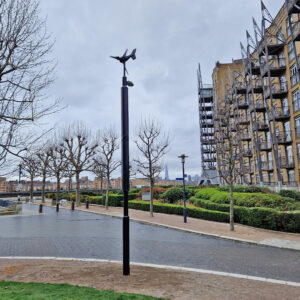
Install permanent lighting without extending mains cabling, trenching across operational areas or waiting for a new electrical connection.
Avoid excavating roads, pathways, car parks and landscaped areas, reducing disruption and the risk of striking existing underground services.
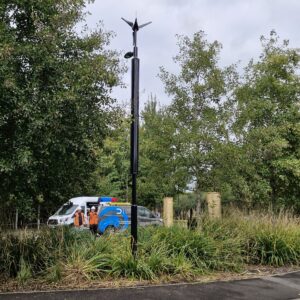
Compare the complete cost – including dependencies – of bringing power to the lighting point with an autonomous system designed to operate independently.
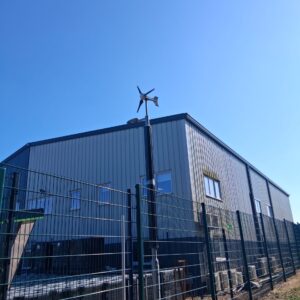
ReLuminate® combines solar generation, wind generation and battery storage in one self-contained lighting system.
Hybrid generation provides two complementary renewable energy sources, helping ensure reliable year-round performance through variable UK conditions and shorter winter days.
The system generates and stores energy at the point of use, allowing permanent lighting to operate without an external electrical supply.
Without the need to extend electrical infrastructure to every lighting point, ReLuminate® can make previously awkward locations much simpler to illuminate.
Typical applications include:
The case is often strongest where only a small number of lighting points are needed, or where connecting them would mean disproportionately expensive or disruptive enabling works.
Off-grid lighting is not automatically the right answer for every permanent requirement.
Where an electrical supply is already nearby or cabling can easily be incorporated into planned works, a conventional connection may still be the simplest solution.
But where trenching, reinstatement, road crossings, buried services or distance from existing infrastructure start adding cost, risk and complexity, it makes sense to compare both options before committing.
We can review your proposed location, lighting requirement and connection constraints to establish whether permanent off-grid lighting offers the stronger practical and commercial case.
Yes. ReLuminate® can be specified as a permanent lighting solution, generating and storing its own energy at the point of use rather than relying on an external mains supply. Suitability should be assessed against the location, required light levels, operating hours and local conditions.
The system combines solar and wind generation with battery storage rather than relying on solar alone. Wind can continue contributing when solar yield is low and after dark, helping support battery charge through shorter winter days. The system should be specified around demanding winter conditions rather than average annual generation.
The strongest applications are generally locations where lighting is required but bringing mains power to the lighting point would be difficult, disruptive or disproportionately expensive. These can include remote car parks, pathways, access roads, boundaries, compounds, service areas and isolated assets. It’s also ideal for situations where the previously installed underground cabling has failed and a direct replacement is looking prohibitively expensive and disruptive.
The comparison should include the complete installation rather than simply the lighting equipment. Mains-powered lighting may require trenching, ducting, cabling, excavation, reinstatement, crossings, specialist labour and connection work. Where those enabling works are substantial, an autonomous system can present a very different cost case.
In that situation, a conventional connection may still be the better option. Permanent off-grid lighting is particularly valuable where extending power introduces significant cost or disruption. We can help you compare the practical requirements of both approaches; this is preferable to assuming either technology is automatically the right answer.
Yes. Avoiding extensive excavation and cabling can be particularly useful on occupied or operational sites, where works to car parks, roads, pathways or access routes could otherwise disrupt normal activity. The proposed installation still needs to be assessed for lighting requirements and site conditions.
Site conditions matter. Significant shading can reduce solar generation, while sheltered locations may limit wind generation. Suitability therefore needs to be assessed against exposure, energy demand, battery capacity and the required operating profile before a permanent off-grid lighting system is specified.
Potentially. Where existing underground cabling has failed, repairing or replacing it may involve considerable excavation and reinstatement. An autonomous lighting system can provide an alternative worth assessing, particularly where the existing electrical infrastructure is difficult or costly to access.
Generating electricity from renewable sources at the point of use avoids the need for grid electricity solely to power the lighting installation. Off-grid lighting can therefore form part of a wider estate decarbonisation strategy. On relevant BREEAM-assessed projects it may also contribute to evidence around external-lighting efficiency, controls and night-time light pollution, subject to the applicable scheme, design and assessor.
Start with the requirement rather than the technology. Consider the lighting demand, operating hours, site exposure and location alongside the cost, disruption and complexity of bringing mains electricity to the lighting point. We can review these factors and help you establish which approach makes the most practical and commercial sense.
If extending mains power is adding disproportionate cost, excavation or disruption to your lighting project, we can help you assess whether an autonomous alternative makes better sense.
Share a few details about your location and lighting requirements and we’ll recommend a practical approach.