Trialling hybrid off-grid lighting in support of Net Zero estate ambitions
As defence estates continue to modernise, infrastructure decisions are increasingly being assessed not only on cost and operational need, but also on their contribution to wider sustainability objectives.
At RAF Leeming, the failure of underground cabling created a need to restore lighting to part of the estate. With conventional repair costs broadly comparable to an off-grid alternative, the estate team saw an opportunity to trial a lower-impact solution aligned with the RAF’s wider Net Zero ambitions.
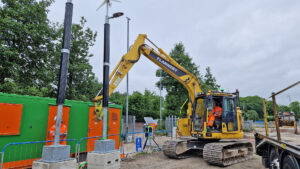

VentaVolt supplied ReLuminate® hybrid solar-wind lighting, giving the team an autonomous system they could assess in real operating conditions without the need for intrusive groundworks.
The challenge
When the estate team at RAF Leeming discovered that underground cabling serving existing hard-wired lighting had failed, there was a choice to be made. Rather than proceeding directly with excavation and cable repair, they considered whether an autonomous off-grid system could meet the same operational requirement while reducing disruption and supporting sustainability goals.
A key consideration was winter performance. Experience shared through the RAF’s twinned bases in Miramar, USA, and Cazaux, France, suggested that solar-only systems could perform well in summer but become less reliable during winter, when shorter daylight hours and prolonged cloud cover reduce solar generation.
For this reason, the team wanted to trial a solution that offered greater resilience across the year.
The solution
VentaVolt was selected because ReLuminate® combined both solar and wind generation in a single off-grid lighting system. By using two renewable energy sources, the system offered a more balanced alternative to solar-only lighting, particularly during darker and more changeable winter conditions.
The ten units were installed to illuminate the main access road into the base, without repairing or replacing the failed underground cable, giving the estate team a practical opportunity to monitor performance before considering similar applications elsewhere on the base.
As with any new technology trial, the deployment involved a period of monitoring, adjustment and optimisation. One area refined during commissioning was the lighting delay following PIR activation. On quieter estate roads, vehicles were typically detected only when close to the lighting columns, which meant the standard settings did not always provide illumination early enough on approach; following review, the lights were set to a 10-minute delay, which has proven effective for the location.
Practical outcomes
The deployment showed how autonomous lighting can offer a viable alternative to conventional cable repair in selected estate locations. The key practical benefits included:
Avoided groundworks
The system eliminated the need for disruptive excavation to locate and repair the failed underground cable.
Cost-neutral sustainability trial
Because the off-grid option was comparable in cost to the conventional repair or replacement route, the estate team could trial a more sustainable solution without paying a premium.
Reduced dependence on fixed infrastructure
The lighting operated independently of the grid, reducing reliance on underground cabling and associated repair requirements.
Improved winter confidence
The hybrid solar-wind configuration provided a more resilient model than solar-only alternatives, particularly in the context of shorter days and prolonged cloud cover.
Operational learning
The trial helped identify practical requirements around sensor angle, illumination delay and system monitoring, creating useful insight for future estate applications.
A practical step towards lower-impact estate lighting
For this RAF estate, ReLuminate® provided a cost-neutral alternative to repairing failed underground lighting infrastructure, while supporting a live trial of hybrid renewable technology.
The project demonstrated the value of testing autonomous lighting under real site conditions, particularly through the winter months when lighting demand is highest and renewable generation is most challenged.
For sites where underground cabling has failed, or where trenching and permanent infrastructure works would be disruptive, hybrid off-grid lighting can offer a practical middle ground: dependable illumination without additional cabling, excavation or reliance on the grid.