“We tried solar-only lighting towers – they were fine until the weather turned.” This is the sort of comment that comes up again and again when talking about winter construction site lighting. Through spring and summer, solar-only lighting towers often perform exactly as expected. Then autumn arrives, the clocks go back, and suddenly batteries drain faster, run-times tighten, and diesel backup quietly reappears. The problem isn’t solar technology. It’s that many off-grid lighting tower systems are sized and sold around average or summer-optimised conditions. Winter exposes the gap between theoretical performance and operational reality. So what actually changes when you move from solar-only to hybrid solar-wind lighting towers? And why do hybrid units behave differently once winter sets in?
The winter problem with solar-only systems
Solar generation is highly predictable, but that predictability cuts both ways. In winter, three factors hit at once: shorter days, lower sun angles, and a higher frequency of overcast conditions. Even with efficient panels, energy yield drops sharply compared to summer months.
In the UK, December solar output can be less than a third of June levels for the same installed capacity. That doesn’t make solar unusable, but it does mean margins shrink fast. A system that ‘just about works’ on paper quickly becomes fragile on site. In real terms, that fragility shows up as reduced overnight run-time, operators dimming lights earlier than planned to preserve battery life, and diesel contingency being introduced after a run of dull days. At that point, the environmental and operational benefits of diesel-free lighting start to erode.
This isn’t poor operation. It’s what happens when a single generation source is asked to carry winter demand on its own.
Hybrid solar-wind lighting boasts superior winter performance
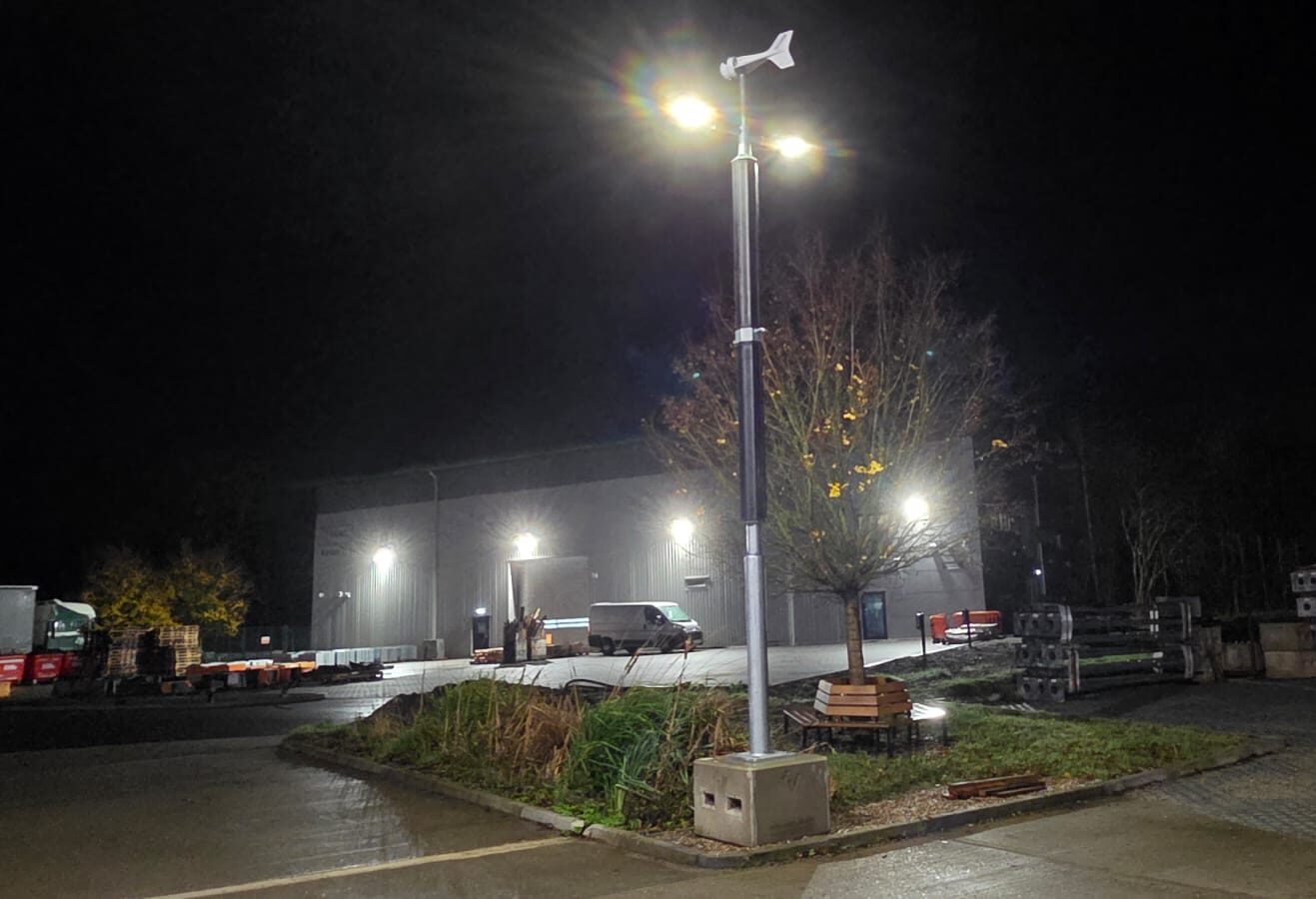
Hybrid solar-wind lighting towers combine solar panels and wind generation feeding a shared battery and control platform. The objective isn’t to chase peak output, but to stabilise energy input across changing weather conditions.
There’s solid evidence behind this approach. Reviews of hybrid renewable energy systems show that combining wind and solar consistently improves overall reliability compared with either source alone, specifically because each compensates when the other underperforms. That matters in winter. A key UK climatology study based on long-term data show that wind and solar resources are only weakly correlated – often negatively so. In simple terms, dull days are frequently windy, and calm days are often brighter. This complementarity is one of the main reasons hybrid systems are widely used in off-grid and remote power applications. Critically for lighting, wind doesn’t stop at sunset. While solar output drops to zero overnight, wind can continue charging batteries through the evening and early morning, directly supporting long winter run-times.
What happens in bad weather, not ideal conditions
Consider two common winter scenarios. Three consecutive overcast days with strong winds. A solar-only lighting tower will draw steadily from its battery with limited opportunity to recover. A hybrid unit, by contrast, can offset much of that deficit through wind input, maintaining usable run-time with less intervention. Now consider three overcast, still days, the hardest case for any renewables-led system. Even here, the hybrid solar-wind lighting tower’s value lies in risk reduction. With two generation sources feeding the battery, the likelihood of a complete generation drought is lower than with solar alone.
Large-scale energy system modelling supports this principle. Studies examining extreme low-generation events show that hybrid solar-wind configurations significantly reduce the frequency and severity of multi-day ‘renewable droughts’ compared with single-source solar systems. Scale aside, the logic translates directly to off-grid lighting: fewer periods where nothing is coming in at all.
Reliability under real UK site conditions
The difference between solar-only and hybrid systems becomes clearer when viewed through site realities rather than specification sheets.
On a typical UK construction site needing 10-12 hours of lighting per night, solar-only towers can perform adequately in winter when conditions are favourable. Problems arise during extended poor weather, when run-time becomes marginal, and diesel backup creeps back in. Hybrid systems are more forgiving in winter. Wind input stabilises battery charge, reducing the need to dim lights early or intervene mid-shift. From a supervisor’s perspective, performance feels more predictable and less dependent on checking forecasts and battery states.
On remote or constrained sites, the benefit compounds. Where refuelling access is difficult or disruptive, reducing emergency call-outs becomes a tangible operational gain. Hybrid units cut the likelihood that a tower underperforms just when access is hardest. For high-risk environments – rail, utilities, highways – the conversation shifts again. Here, lighting failure isn’t inconvenient, it’s unacceptable. Hybrid systems are specified not because they are greener, but because they introduce redundancy into the power strategy.
Designing for the worst week, not the average one
A recurring mistake in off-grid lighting procurement is designing for average conditions. On paper, the system copes. On site, reality is harsher. Winter programmes are defined by their most difficult weeks: prolonged cloud cover, high demand, zero tolerance for failure. Hybrid systems are better aligned to that reality because they remove the single point of failure inherent in solar-only designs. Two generation sources with different weather dependencies reduce exposure to prolonged low-input periods. Pair that with battery capacity sized to ride out short deficits, and the system is no longer balanced on a knife edge.
For decision-makers, this is about resilience, business continuity and risk mitigation, not just sustainability claims.
Cost, carbon and practical trade-offs
Hybrid hybrid solar-wind lighting towers can look more expensive on day one. That’s true if cost is assessed purely on hire rate. A more useful comparison is cost per dependable, lit hour through winter. When reduced diesel use, fewer emergency swaps, fewer call-outs and less management time are factored in, the economics shift.
There are also safety and ESG implications. Removing diesel from lighting eliminates a visible source of on-site emissions and refuelling risk; studies consistently show that reducing fuel handling lowers incident exposure. At the same time, hybrid systems support more credible construction-phase carbon reporting by replacing fuel estimates with metered energy data.

How to interrogate winter performance claims
Not all ‘year-round’ claims are equal. Buyers should expect suppliers to explain how winter performance is modelled. Useful questions include which months and locations underpin quoted run-times, whether real winter deployment data exists, and how systems are designed to cope with consecutive low-generation days. Red flags remain familiar: reliance on “up to X hours” language without conditions, no mention of winter months, and vague assurances that systems are “suitable all year round” without explaining how.
Putting hybrid to the winter test
The most effective way to assess hybrid lighting isn’t theoretical. It’s practical.
Many teams start by running a head-to-head trial on a live site: solar-only units in one area, hybrid units in another. Over a few winter weeks, differences in intervention, reliability and confidence become clear. If you’ve already discovered the limits of solar-only towers once the weather turns, the next step isn’t reverting to diesel. It’s specifying systems designed for winter reality, not summer averages.