Sustainable, emission-free lighting solutions designed for modern UK construction
By mid-afternoon on a UK site in January, the light drops faster than the workload. Plant is still moving, deliveries are still arriving, crossings are still busy – and in the background, generators rumble away feeding diesel towers and temporary cabling that were always a compromise.
It works, until it doesn’t. A tower runs dry on an access route, a cable is dislodged at a pedestrian interface, noise at the boundary tips neighbours over the edge. The question is no longer “do we have enough light?” but “why are we still accepting this level of risk and hassle when credible diesel-free options exist?”
On paper, a diesel lighting tower still looks familiar and safe. Hire rates are known, the kit is understood, supervisors have used it for years.
But winter exposes the gaps. Fuel use spikes as nights lengthen; refuelling runs become a mini-programme of their own, threaded through already stretched shifts; cables are routed where the ground will accept them rather than where the RAMS would prefer – across walkways, skirting welfare and materials, protected in places but inevitably exposed in others.
At the boundary, generator noise and exhaust sit awkwardly alongside ESG commitments and ‘good neighbour’ language in bids and reports. Residents, schools and hospitals are less tolerant of low-level nuisance that runs long into the evening. Internally, governance teams and frameworks such as BREEAM Version 7 are moving away from intent and towards verifiable reduction of site impacts.
Every refuel, relocation and workaround is another potential failure point. When a tower fails at shift change, or a cable is disconnected at a busy crossing, the cost is immediate.
A diesel-free tower isn’t wishful thinking about sunshine. A modern hybrid off-grid unit is built around real UK winter conditions: short days, long overnights, unsettled weather.
High-efficiency LED luminaires sit on a mobile mast. Power comes from an integrated combination of solar and wind feeding into a battery bank sized for predictable runtime, managed by a controller tuned for the duty cycle your programme actually needs.
Everything is self-contained. There is no external generator to position and protect, no trenching or surface cabling back to a distribution board, no dependency on the temporary site power layout. Towers can be placed exactly where the risk sits – at pedestrian crossings, welfare approaches, compound edges and interfaces – and redeployed in minutes as phases move on.
For main contractors, that changes the geometry of winter lighting. The layout is driven by risk and access, not by where it’s easiest to pull a cable.
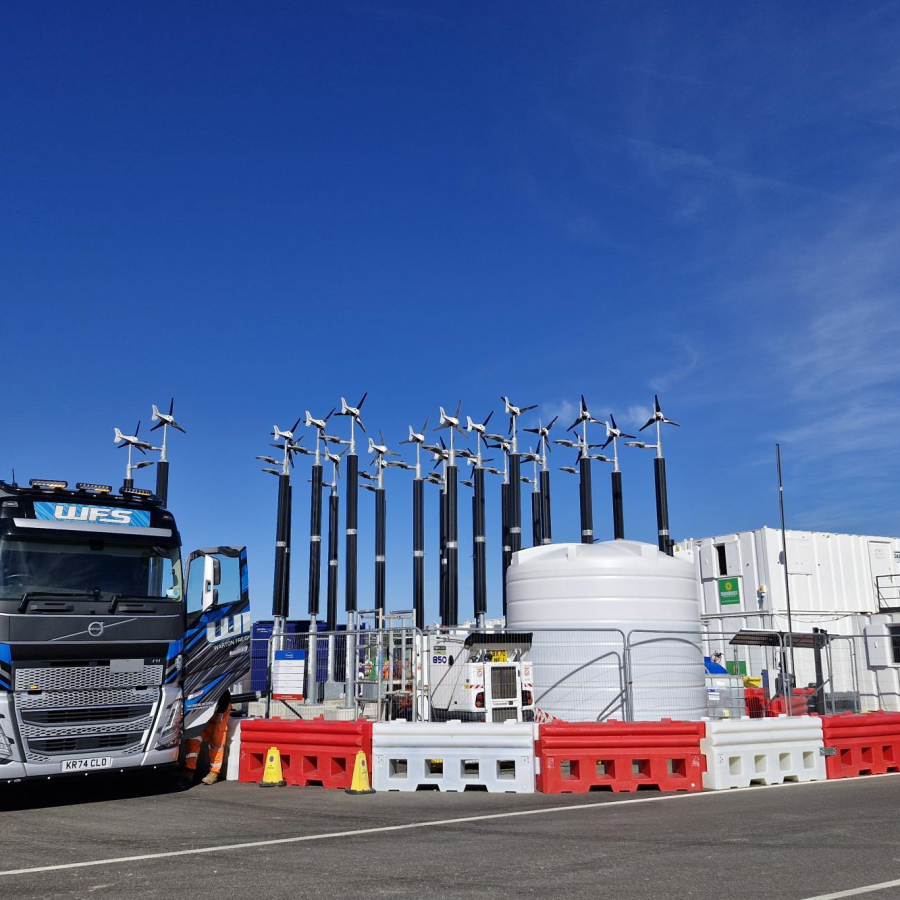

With no fuel to manage for lighting, bowsers are reserved for plant that genuinely needs diesel. Supervisors spend less of the day thinking about which tower is close to running dry, and more on programme and risk.

Removing lighting cabling from pedestrian and vehicle routes simplifies both RAMS and the physical environment. Towers can be placed at gate lines, loading bays and crossings without dragging power to them.
Off-grid lighting removes on-site refuelling from the lighting equation and introduces metered data for energy use, which reads well in BREEAM Man 03 submissions, PAS 2080 reporting and client ESG files.

Near-silent operation at the hoarding reduces a common complaint trigger, particularly near residential areas, schools and hospitals. This sits better with ‘good neighbour’ and social value commitments.
If your winter lighting strategy still leans heavily on diesel towers, you are not alone. But the combination of operational risk, neighbour expectations and assurance frameworks means ‘business as usual’ is getting harder to defend.
We can help you identify where diesel-free lighting towers will remove the most risk, cost and hassle on your current and upcoming projects, and how to introduce hybrid off-grid units alongside existing kit without disrupting live programmes.
Share a few details about your sites and constraints, and we’ll outline a practical diesel-free lighting plan you can test this winter.